
Polytetrafluoroethylene (PTFE), often called the “King of Plastics,” is widely used in chemical processing, electronics, medical devices, aerospace, and other industries due to its exceptional chemical resistance, extremely low friction coefficient, and broad operating temperature range (-200°C to +260°C). However, PTFE processing is fundamentally different from other thermoplastics—it does not flow like conventional plastics and cannot be injection molded using standard methods. This unique characteristic requires a complete set of specially designed equipment and processes.
So what equipment is actually needed to turn PTFE raw material into finished products? This article walks you through the entire production process, machine by machine.
I. Why PTFE Processing Is Different
Before diving into the equipment, it helps to understand why PTFE is “special.”
PTFE has an extremely high melt viscosity—even at 380°C, it remains at 10¹⁰ poise. It does not flow like ordinary thermoplastics even when heated above its melting point, making conventional injection molding impossible. The mainstream PTFE forming processes include:
Compression Molding: PTFE powder is loaded into a mold, compacted under a hydraulic press, then sintered in a furnace at high temperature.
Ram Extrusion: PTFE powder or preformed blanks are loaded into a chamber and pushed through a die by a ram plunger.
Paste Extrusion: PTFE resin is mixed with a lubricant to form a paste, then forced through a tapered die by a pusher.
Skiving: PTFE preforms are sliced into thin films on a lathe.
CNC Precision Machining: Sintered PTFE parts undergo secondary operations such as turning, milling, and drilling.
Each process route requires a different combination of equipment.
II. Complete PTFE Production Equipment Overview
1. Raw Material Preparation Equipment
Before PTFE raw material enters the forming stage, it often requires pretreatment.
V-Type Powder Mixer Machine is used to uniformly blend PTFE resin with various modifiers such as glass fiber, carbon fiber, graphite, and molybdenum disulfide to meet different performance requirements. For paste extrusion, the mixer also blends PTFE resin with lubricants to form a homogeneous paste.
Pre-sintering Furnace is used to pre-sinter PTFE powder, improving its forming properties.
PTFE Block Crusher and Electric Sieve Powder Machine are used to break pre-sintered PTFE lumps into powder and screen them into uniform particle sizes.
2. Compression Molding Equipment
Compression molding is one of the most fundamental and commonly used methods for PTFE forming, particularly suitable for producing sheets, rods, gaskets, seals, and other products.
Hydraulic Molding Machine is the core equipment for compression molding. PTFE powder is loaded into a mold and compacted under high pressure (typically 20-235 MPa) in a hydraulic press. For large products or high-density requirements, high-tonnage presses are needed.
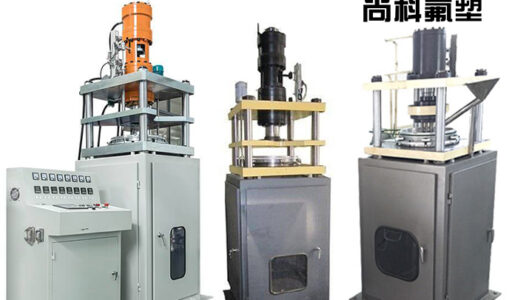
PTFE Double-Action Semi-Automatic Molding Machine represents a more advanced molding solution. It features synchronized upper and lower hydraulic cylinders that apply pressure from both directions simultaneously. This bi-directional compression eliminates the central porosity and density gradients common in single-cylinder presses, ensuring consistent mechanical properties throughout the part. The machine is engineered for pure and modified PTFE grades and produces a wide variety of molded parts including rods, tubes, rings, custom geometries, and large-area seals. Production height can reach up to 300mm or more, with outside diameters up to 2000mm.
PTFE Fully Automatic Press Molding Machine is designed for large-scale production, enabling high-efficiency automated operations with consistent quality and precision.
3. Extrusion Equipment
Extrusion is the core process for producing continuous-length PTFE products such as tubes, rods, and hoses.
PTFE Rod Ram Extruder Machine is used for producing PTFE rods. PTFE powder or preformed blanks are loaded into the chamber, and a ram plunger pushes the material through a die, followed by sintering in a furnace. Different models are available for different rod diameters:
Model PFB20: diameter range 4-20mm, vertical extrusion
Model PFB80: diameter range 25-80mm, horizontal extrusion
Model PFB150: diameter range 80-150mm, horizontal extrusion
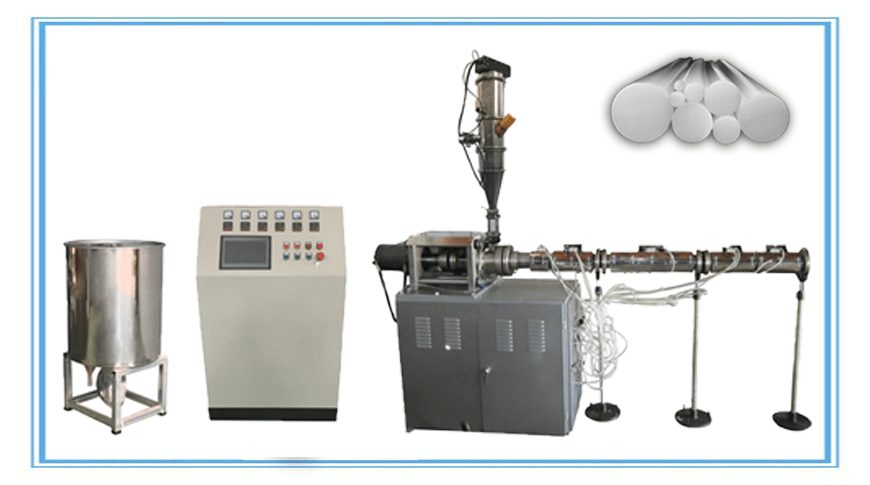
All models feature PLC + touch screen control systems for automated continuous production.
PTFE Tube Ram Extruder Machine is designed for manufacturing PTFE tubing. Models such as PFG150, PFG300, and PFG500 can produce tubes with outside diameters from 20mm up to 500mm. These vertical ram extruders are controlled by PLC systems, operate automatically, and feature stable long-term operation with low noise.
PTFE Paste / Hose Extruder Machine is used for producing PTFE paste hoses. In this process, PTFE resin is mixed with a lubricant to form a paste, which is then forced through a tapered die by a pusher to achieve a uniformly aligned fibrous structure, followed by drying and sintering. This equipment can produce PTFE hoses with outside diameters ranging from 0.5mm to 70mm and wall thicknesses from 0.025mm to 2mm. The machine is equipped with a PLC control system and touchscreen HMI for real-time monitoring of temperature, pressure, and speed, with temperature control accuracy of ±1°C. Maximum production speed can reach 20m/min. These hoses are critical in industries such as chemical processing, automotive, aerospace, medical, and food processing.
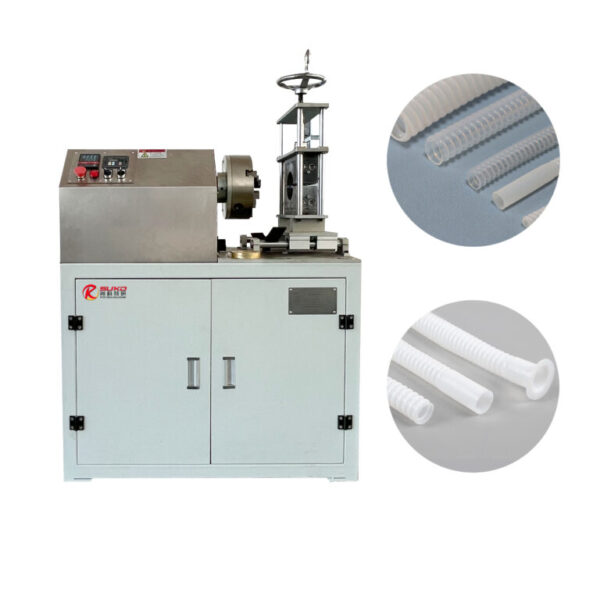
PTFE Corrugated Machine is used for producing PTFE corrugated tubes.
4. Sintering Equipment
Sintering is an indispensable step in PTFE forming. After compression molding or extrusion, the PTFE preforms must be sintered at precisely controlled temperatures to allow PTFE particles to melt and recrystallize, achieving final mechanical properties.
PTFE Sintering Furnace / Oven is the key equipment for this process. PTFE sintering temperatures typically range from 370°C to 380°C. The furnace must provide precise temperature control and uniform temperature distribution throughout the heating chamber to ensure consistent product quality. For tube extrusion lines, the sintering furnace is usually integrated with the extruder for continuous production.
5. Auxiliary and Finishing Equipment
Beyond the main forming equipment, PTFE production requires a range of auxiliary machinery.
PTFE Film Skiving Machine is used to slice PTFE rod or sheet preforms into thin films. High-precision skiving machines can control film thickness within a range of 0.20mm to 7mm. These machines feature PLC programmable control, Mitsubishi servo motors for precise positioning, and touchscreen operation. PTFE skived film is widely used in electronics and semiconductor industries for its excellent dielectric capability, anti-aging, and anti-corrosion properties.
PTFE Paste Gasket Machine is specialized equipment for manufacturing PTFE gaskets with excellent sealing performance and chemical resistance.
Cutting Machine is used to cut extruded or molded PTFE rods and tubes to required lengths.
CNC Machining Equipment is used for precision secondary processing of sintered PTFE parts. PTFE can be processed through conventional CNC turning, face milling, and deep hole drilling.
PTFE Recycling Machine offers complete PTFE waste recycling solutions.
III. Complete Production Line Configurations
Different product types require different production line configurations:
PTFE Rod / Tube Production Line typically includes: V-Type Mixer → Rod Ram Extruder or Tube Ram Extruder (or Molding Machine) → Sintering Furnace → Cutting Machine → (if needed) Film Skiving Machine.
PTFE Hose Production Line typically includes: V-Type Mixer → Preformer → Paste Extruder → Drying Oven → Sintering Furnace → Take-up Device.
PTFE Molded Products Line typically includes: V-Type Mixer → Hydraulic Molding Machine → Sintering Furnace → (if needed) CNC Machining Equipment.
PTFE Film Production Line typically includes: V-Type Mixer → Molding Machine (for preform) → Sintering Furnace → Film Skiving Machine.
IV. How to Choose the Right PTFE Equipment
When selecting PTFE production equipment, consider the following factors:
Product Type: Different products require different forming processes. Rods and tubes are suited for ram extrusion, gaskets and seals for compression molding, and films for skiving.
Production Scale: High-volume production benefits from highly automated equipment (such as PLC-controlled extruders), while small-batch or multi-product operations may find semi-automatic equipment more flexible.
Precision Requirements: High-precision products require equipment with advanced control systems.
Material Type: Pure PTFE and modified PTFE (with glass fiber, carbon fiber, etc.) have different equipment requirements.
V. SuKo PTFE Machinery – Your One-Stop Partner
Jiangsu SuKo Fluoroplastic Machinery Technology Co., Ltd. (SuKo) is a professional manufacturer dedicated to the design and production of high-performance PTFE and UHMWPE processing machinery. Founded in 2012 in Changzhou, Jiangsu, China, the company combines advanced engineering capabilities with a strong manufacturing system, supported by experienced engineers, technicians, and a professional sales team.
SuKo’s main products include:
PTFE Rod Ram Extruder (PFB20, PFB80, PFB150)
PTFE Tube Ram Extruder (PFG150, PFG300, PFG500, PFG600)
PTFE Hose Paste Extruder
PTFE Double-Action Semi-Automatic Molding Machine
PTFE Fully Automatic Press Molding Machine
PTFE Sintering Furnace / Oven
PTFE Film Skiving Machine
V-Type Powder Mixer Machine
PTFE Corrugated Machine
PTFE Paste Gasket Machine
PTFE Recycling Machine
SuKo’s factory is equipped with advanced processing and testing equipment, ensuring every machine meets strict quality standards. From initial design to final delivery, SuKo provides full technical support and after-sales service to help customers achieve stable and efficient production. The company’s products are widely used in industries such as chemical processing, medical equipment, automotive, and electronics. SuKo has established long-term cooperative relationships with customers in India, Russia, the Philippines, and other countries.
SuKo’s R&D team focuses on developing innovative solutions based on market demand, customer feedback, and polymer processing technology advancements. The company’s equipment ranks first in China and leads in export volume.
For more product information or selection assistance, visit the SuKo official website:
FAQ (Frequently Asked Questions)
Q1: Why can’t PTFE be injection molded like ordinary plastics?
A: PTFE has an extremely high melt viscosity—even at 380°C, it remains at 10¹⁰ poise. It does not flow like conventional thermoplastics when heated above its melting point, so it cannot be injection molded using standard methods. Special processes such as compression molding, ram extrusion, and paste extrusion are required.
Q2: What equipment is needed to produce PTFE rods?
A: Producing PTFE rods primarily requires a PTFE Rod Ram Extruder and a Sintering Furnace. Depending on the rod diameter, different models are available, covering diameters from 4mm to 150mm.
Q3: What sizes can PTFE hose extruders produce?
A: PTFE Paste Hose Extruders can produce PTFE hoses with outside diameters ranging from 0.5mm to 70mm and wall thicknesses from 0.025mm to 2mm.
Q4: What is the difference between compression molding and extrusion?
A: Compression molding involves loading PTFE powder into a mold and compacting it under a hydraulic press—suitable for sheets, gaskets, seals, and other non-continuous products. Extrusion pushes PTFE through a die using a ram plunger for continuous production—suitable for tubes, rods, and other continuous-length products.
Q5: What is a double-action molding machine and what are its advantages?
A: A double-action molding machine uses synchronized upper and lower hydraulic cylinders to apply pressure from both directions simultaneously. This bi-directional compression eliminates the central porosity and density gradients common in single-cylinder presses, ensuring consistent mechanical properties throughout the part.
Q6: What PTFE equipment does SuKo provide?
A: SuKo provides a complete range of PTFE production equipment including rod ram extruders, tube ram extruders, hose paste extruders, molding machines (semi-automatic and fully automatic), sintering furnaces, film skiving machines, V-type mixers, corrugated machines, gasket machines, and recycling machines. For more information, visit https://ptfe-machinery.com/.
SuKo Fluoroplastic – Your Trusted PTFE Equipment Partner
Website: https://ptfe-machinery.com/
Email: info@ptfe-machinery.com
 English
  Русский