
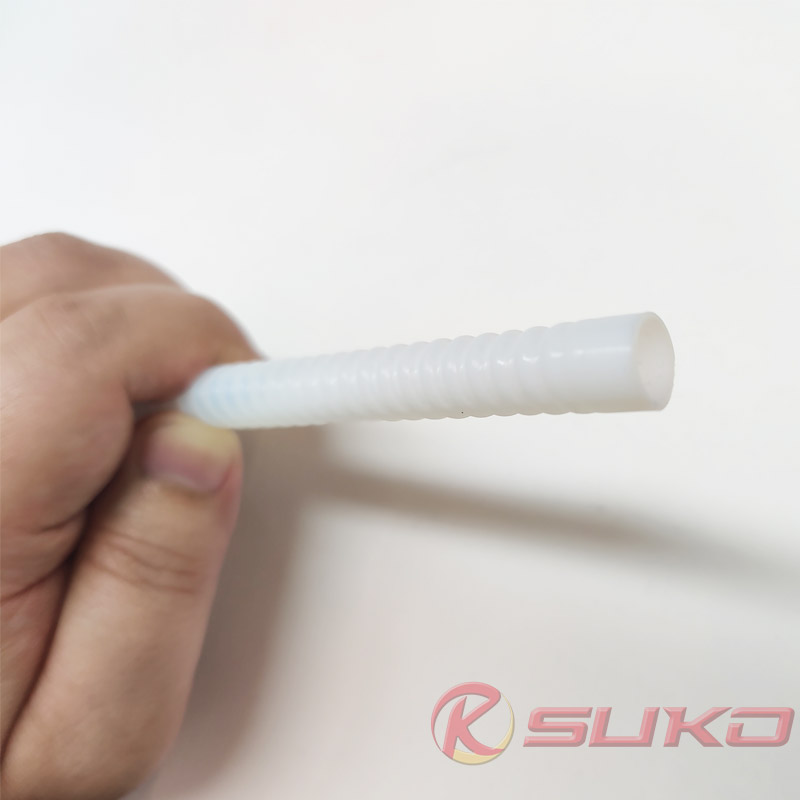
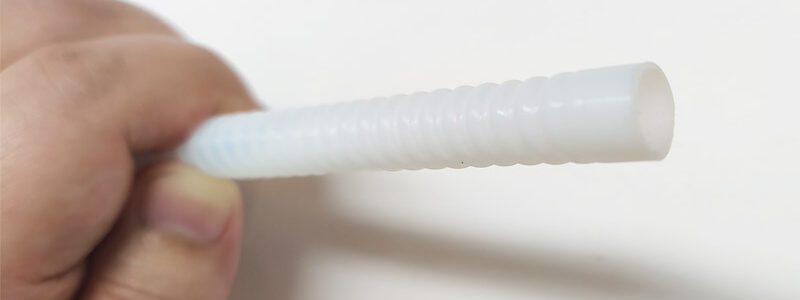
The video shows a SUKO PTFE corrugated hose machine continuously producing 10 × 12 mm PTFE hose. Smooth PTFE hose enters the machine and passes through custom tooling. It then develops a continuous and uniform corrugated profile.
The complete process normally has two stages. First, a paste extrusion line produces the smooth PTFE hose. The corrugating machine then handles feeding, heating, corrugation forming, cooling and setting.
The 10 × 12 mm Hose in This Production Run
The 10 × 12 mm specification normally refers to the original smooth PTFE hose dimensions:
- Inside diameter: 10 mm
- Outside diameter: 12 mm
- Material: PTFE
- Product form: Flexible corrugated hose
- Corrugation pitch: Determined by the tooling
- Corrugation depth: Determined by the tooling
- Finished length: Customizable
Corrugation creates new peak and valley diameters. Therefore, the finished dimensions must be confirmed according to the customer drawing, sample and measurement method.
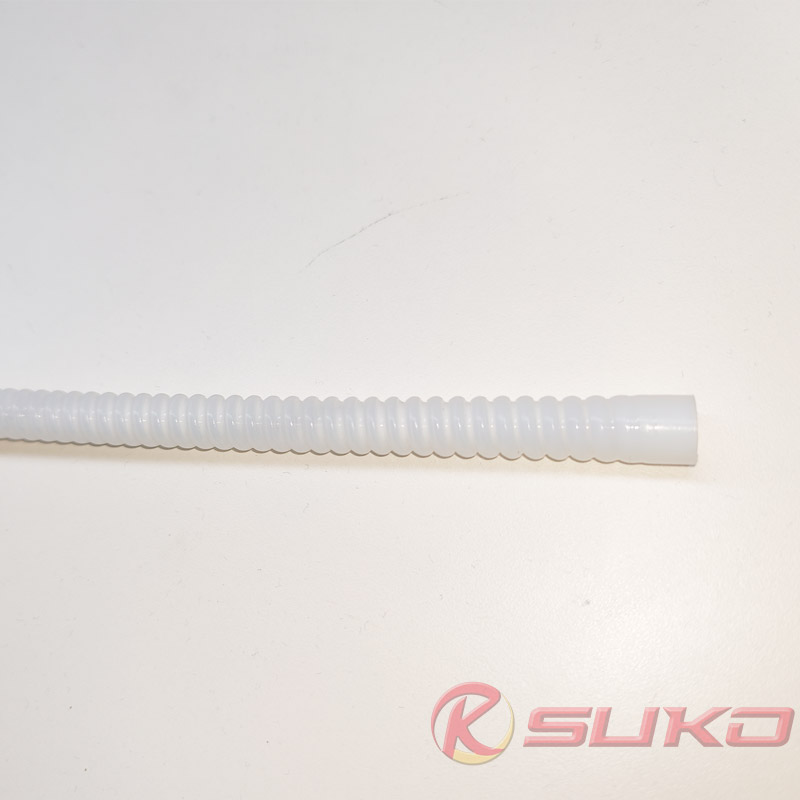
How a PTFE Corrugated Hose Machine Works
1. Prepare the Smooth PTFE Hose
PTFE fine powder is processed through material preparation, preforming, paste extrusion and subsequent treatment. This produces the original 10 × 12 mm smooth hose.
The outside diameter, wall thickness and surface condition of this hose affect the final corrugation. Dimensional variation in the original hose may cause changes in pitch and peak diameter.
2. Install the Corrugation Tooling
The correct tooling is installed according to the 10 × 12 mm hose and the required corrugation profile.
The tooling determines:
- Corrugation pitch
- Corrugation depth
- Peak diameter
- Valley diameter
- Corrugation shape
- Straight end configuration
Other dimensions and profiles can be produced by changing the tooling within the machine’s designed operating range.
3. Feed the Hose Into the Forming Section
Guide and feeding mechanisms move the smooth PTFE hose continuously into the corrugation-forming section.
The hose feeding speed must remain synchronized with the tooling speed. Incorrect synchronization may cause uneven pitch, local stretching or wall deformation.
4. Heat and Form the Corrugations
The hose enters the forming section under controlled conditions. Custom tooling acts continuously on the hose surface and converts the smooth tube into a corrugated structure.
Heating, feeding and forming speeds must work together. Suitable settings help maintain consistent corrugations without excessive wall stretching or folding.
5. Cool and Set the Profile
After forming, the hose is cooled to stabilize its final shape.
A controlled setting process helps reduce corrugation recovery. It also maintains a consistent pitch and profile along the full hose length.
6. Coil or Cut the Finished Hose
The finished PTFE corrugated hose can be collected in continuous coils. It can also be cut into specified lengths.
Straight ends can be retained when required for connections, assembly or secondary processing.
What Is Checked After Production?
The finished 10 × 12 mm PTFE corrugated hose is inspected for:
- Original hose inside and outside diameters
- Corrugation peak and valley diameters
- Uniform corrugation pitch
- Wall damage or excessive stretching
- Flattening during bending
- Finished length and end condition
- Overall appearance consistency
Can One Machine Produce Different Hose Sizes?
Yes, provided the hose dimensions remain within the machine’s designed operating range.
Different PTFE hose sizes and corrugation profiles can be produced by changing the tooling. Feeding, heating and forming settings must also be adjusted.
The 10 × 12 mm hose is the actual specification shown in this video. It is not the only size the machine can produce.
SUKO PTFE Corrugated Hose Equipment
SUKO develops and manufactures PTFE hose extrusion lines, corrugation-forming machines and custom tooling. We also manufacture PTFE hose products. Therefore, we can test equipment and adjust tooling using actual product dimensions.
View the machine:
PTFE Corrugated Hose Making Machine
The equipment can be configured according to:
- Required hose size range
- Corrugation profile and tooling
- Feeding and forming speed
- Heating and cooling method
- Continuous coiling or fixed-length cutting
- Integration with a PTFE paste extrusion line
FAQ
Can a PTFE corrugated hose machine process PTFE powder directly?
The corrugating machine primarily converts smooth PTFE hose into a corrugated structure. A complete production process also requires PTFE paste extrusion equipment to produce the original smooth hose.
Can the machine produce other sizes after changing the tooling?
Yes. Other sizes can be produced when they are within the machine’s designed range. The matching tooling and process settings must also be changed.
Can the corrugation pitch and depth be adjusted?
Yes. The pitch, depth and profile are mainly determined by the forming tooling. Custom tooling can be manufactured according to the product drawing.
Can straight sections remain at both ends?
Yes. Straight-end lengths can be designed according to the connection method, assembly space and secondary processing requirements.
Can the corrugating machine connect to a PTFE hose extrusion line?
Yes. SUKO can configure the PTFE paste extrusion equipment, corrugation-forming machine and tooling as an integrated production solution.
Can SUKO perform machine trials and sample production?
Yes. SUKO can test the machine using the required hose dimensions and corrugation profile. The sample-forming result can then be checked before delivery.
Contact SUKO
Contact SUKO for PTFE corrugated hose machines, custom tooling or complete production solutions.
Phone / WhatsApp: +86 19975113419
Contact: https://ptfe-machinery.com/contact/
 English
  Русский