
Description
Short Description
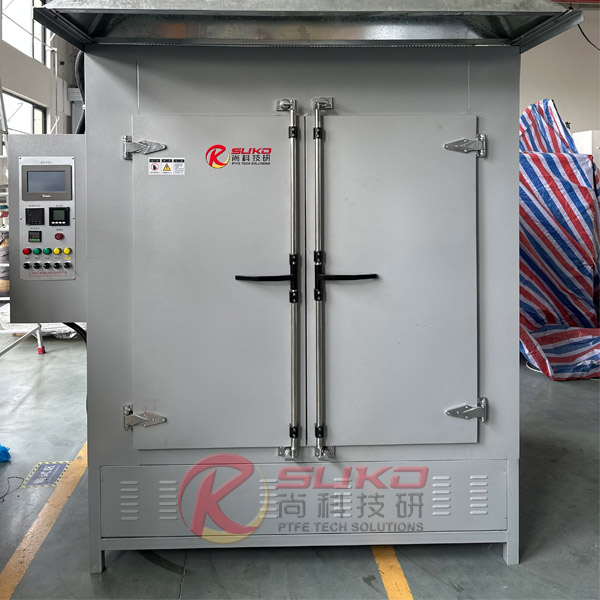
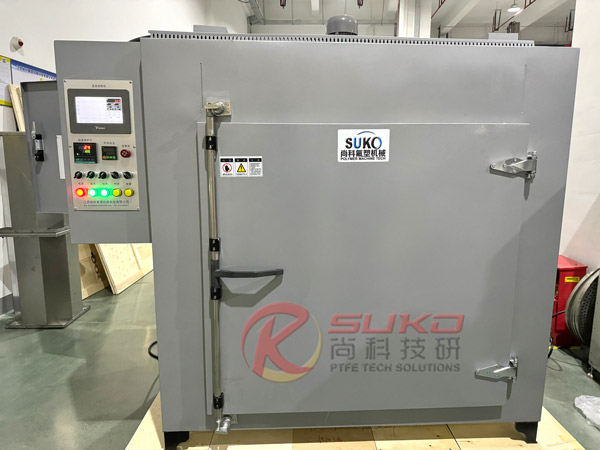
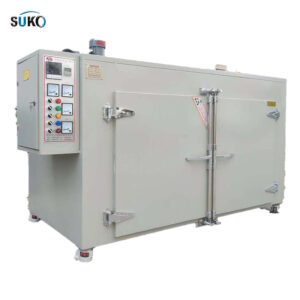
The SUKO industrial rotary sintering furnace / oven uses a multi-layer rotating turntable and circulating hot air to improve heating uniformity across batch-produced components.
• Multi-layer rotating turntable for uniform heating
• 100-450°C programmable temperature range
• Custom chamber size, power and loading structure
• PID digital temperature control with safety protection
• Proven supply experience across multiple international markets
Product Overview
The SUKO industrial rotary sintering furnace, also described as a rotary turntable oven, is designed for uniform sintering, heating, baking, curing, drying and thermal treatment of batch-produced components.
Unlike a conventional static oven, the internal rack rotates continuously during the heating cycle. Each workpiece repeatedly passes through different airflow and heating positions, helping reduce the influence of fixed hot and cold spots.
The rotating structure is particularly useful when processing a large quantity of small molded parts that require consistent heating across multiple trays.
The chamber dimensions, turntable size, number of layers, heating power, temperature range and rotation speed can all be customized according to the customer’s material, workpiece dimensions, batch capacity and thermal process.
Why Use a Rotating Turntable?
In a conventional oven, products remain in one position throughout the entire heating cycle. Differences in airflow, loading density and distance from the heating elements may cause uneven heating between trays or between the center and edge of the batch.
The rotary turntable continuously changes the position of each loaded part inside the chamber.
This helps provide:
• More consistent exposure to circulating hot air
• Reduced temperature differences between loading positions
• More uniform treatment across multiple tray levels
• Improved consistency between products in the same batch
• Better use of the available chamber space
• Reduced need to manually reposition trays during processing
Actual product uniformity also depends on loading pattern, part size, material, heating program and airflow configuration.
Reference Configuration: HJ-121212
The following specifications describe the current reference configuration. Power, chamber dimensions and other parameters change when the machine is customized.
• Model: HJ-121212
• Power supply: 380V, 50Hz, 3 phase
• Installed heating power: 28 kW
• Working temperature: 100-450°C
• Temperature fluctuation: within ±1°C
• Internal chamber: 1200 × 1200 × 1200 mm
• Turntable size: 600 × 600 mm
• Turntable structure: four loading layers
• Rotation speed: 2.5-3 rpm
• Reference capacity: up to approximately 400 small parts per batch
• Inner liner: 2.0 mm stainless steel sheet
• Heating elements: stainless steel electric heating tubes
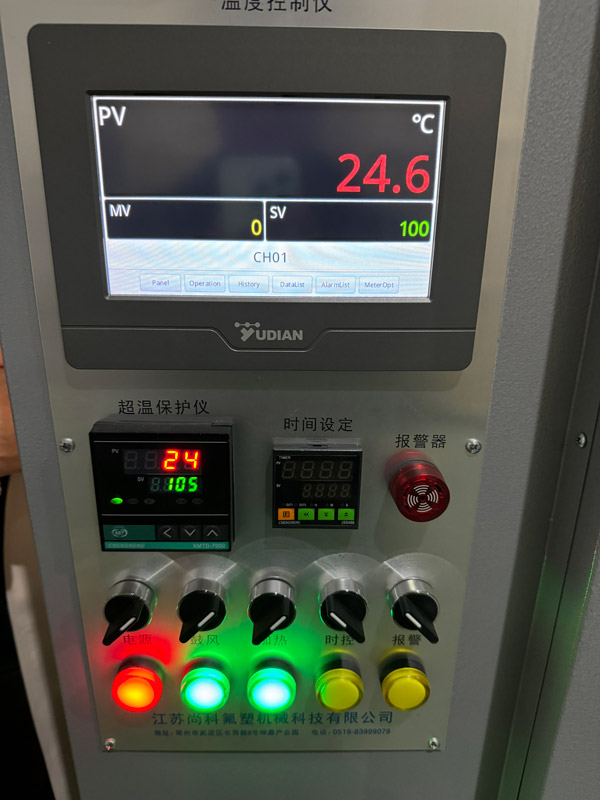
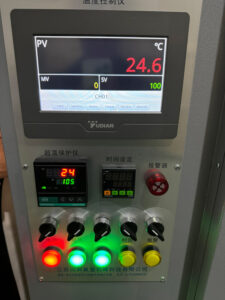
• Temperature control: PID digital setting and measurement
• Temperature sensor: K-type thermocouple
• Control cabinet: separate independent electrical cabinet
• Heating control: multi-zone control with solid-state relays
• Air circulation: multi-directional hot-air circulation
• Display: temperature, voltage, current and operating status
• Alarm: audible and visual warning
• Protection: over-temperature, over-current, motor overheating, phase-loss and short-circuit protection
Batch capacity depends on the dimensions, shape, spacing and loading method of the workpieces.
Heating and Air-Circulation System
Stainless steel electric heating elements are arranged around the heating sections. The heating system works together with guided hot-air circulation to distribute thermal energy throughout the chamber.
The reference oven uses multiple heating and airflow zones. PID temperature controllers receive signals from thermocouples and regulate the heating elements through solid-state relays.
The rotating rack adds another level of consistency by continuously moving the products through the different airflow positions.
Construction
The reference HJ-121212 rotary oven includes:
• A 2.0 mm stainless steel internal liner
• Reinforced external cabinet construction
• High-temperature insulation between the liner and outer shell
• High-temperature glass-fiber door sealing
• Stainless steel electric heating elements
• Multi-layer rotating loading rack
• Independent electrical control cabinet
• Interlocked heating and fan controls
• Accessible components for maintenance
The internal rack, trays and loading fixtures can be redesigned around the customer’s workpiece.
Processes Supported
Depending on the selected temperature range, chamber design and control program, the rotary industrial oven can be configured for:
• Sintering
• Heat treatment
• Annealing and stress relief
• Baking
• Curing
• Preheating
• Drying
• Thermal conditioning
The appropriate configuration must be selected according to the material, required temperature curve, gas release, loading density and production environment.
Typical Applications
Batch Sintering of Molded Parts
The rotating multi-level rack is suitable for processing a large number of small molded parts, including buttons, rings, seals, washers, bushings and other precision components.
Polymer Component Heat Treatment
The oven can be configured for suitable polymer and fluoropolymer components requiring controlled heating, sintering, annealing or stress relief.
PTFE Molded Components
PTFE remains an important proven application. The oven can be used for controlled sintering of molded PTFE parts according to the required heating, holding and cooling program.
Drying, Baking and Curing
With the appropriate temperature and airflow configuration, the oven can also support industrial drying, baking and curing processes for compatible materials and components.
Custom Thermal Processes
SUKO can evaluate special processes based on the customer’s material, workpiece, target temperature curve and production capacity.
PTFE Application Example
One HJ-121212 configuration was developed for batch processing of small PTFE molded components.
The oven used a 1200 × 1200 × 1200 mm chamber with a four-level rotating rack. The loading arrangement was designed to process approximately 400 small components per batch.
During operation, the rack rotated continuously while the hot-air circulation system moved heated air through the chamber. This combination helped expose products on different levels and positions to a more consistent heating environment.
This PTFE project demonstrates the rotary oven’s ability to handle high-volume batches of small precision parts. The same design principle can be adapted to other compatible materials and thermal processes.
Custom Engineering
SUKO does not limit the rotary oven to one fixed chamber or power configuration.
Available customization includes:
• Internal chamber width, depth and height
• Maximum operating temperature
• Installed heating power
• Turntable diameter or loading footprint
• Number of rotating tray levels
• Distance between loading levels
• Turntable speed and speed adjustment
• Tray, fixture and rack design
• Door quantity and opening direction
• Heating-zone arrangement
• Airflow direction and circulation capacity
• Temperature program and control system
• Voltage and electrical standard
• Alarm and safety-protection configuration
When the chamber size or required temperature changes, SUKO recalculates the heating power, insulation, airflow and electrical configuration.
Global Supply Experience
SUKO has supplied customized sintering furnaces and industrial ovens to customers in Russia, Ireland, Romania, Uruguay, South Africa and Southeast Asia.
These projects have involved different chamber dimensions, loading capacities, rotating structures and heating requirements. Each oven is configured according to the customer’s workpiece size, batch quantity, material and thermal process.
Available project records include manufacturing photographs, equipment testing videos and shipment images. Specific customer information can remain confidential.
Machine Video
The following video shows a SUKO rotary sintering oven and its rotating internal loading structure.
Frequently Asked Questions
What is the difference between a rotary oven and a conventional industrial oven?
A conventional oven keeps the loaded products in fixed positions. A rotary oven continuously moves the loading rack, helping different products and tray positions experience a more consistent heating and airflow environment.
Is this called a sintering furnace or an oven?
Both terms are used by industrial customers. “Sintering furnace” emphasizes the high-temperature sintering process, while “industrial oven” is commonly used for controlled heating, baking, curing, drying and heat treatment.
Is this machine only used for PTFE?
No. PTFE is one proven application, but the oven can be configured for other compatible materials and thermal processes. SUKO evaluates the required temperature, airflow, chamber structure and material behavior before confirming the design.
Can the chamber size be customized?
Yes. The chamber width, depth and height can be customized. Heating power, insulation, airflow and electrical components will be recalculated for the new chamber size.
Can the turntable size and number of layers be changed?
Yes. The turntable dimensions, number of layers, tray spacing and loading fixtures can be designed around the customer’s workpieces.
Why does heating power change with oven size?
A larger chamber, heavier batch load or higher target temperature requires more heating capacity. Power is calculated according to the chamber volume, insulation, material load, heating rate and process temperature.
Can the rotation speed be adjusted?
The reference configuration operates at 2.5-3 rpm. Adjustable or alternative rotation speeds can be evaluated according to the workpiece and heating process.
How many products can be processed in one batch?
The reference four-layer configuration can hold approximately 400 small parts. Actual capacity depends on product dimensions, required spacing, tray design and loading density.
Request a Custom Oven Proposal
To configure a suitable rotary sintering furnace / oven, please provide:
• Material to be processed
• Workpiece dimensions and weight
• Quantity per batch
• Required chamber dimensions
• Maximum operating temperature
• Heating, holding and cooling program
• Required temperature consistency
• Preferred tray or fixture arrangement
• Factory voltage and frequency
• Product photographs, drawings or samples
SUKO can provide chamber design, power calculation, turntable configuration and a complete technical proposal based on your production requirements.
Phone / WhatsApp: +86 19975113419
Contact Page: https://ptfe-machinery.com/contact/
 English
  Русский