
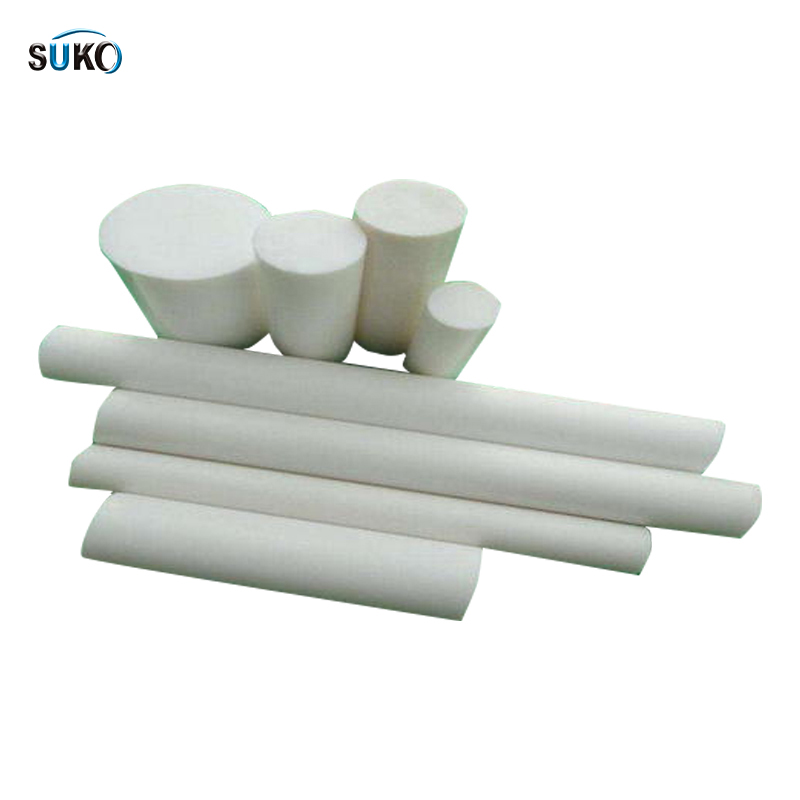
In mechanical, chemical, electrical and sealing applications, many buyers search for Teflon Rod. In material terms, this usually refers to a polytetrafluoroethylene rod, commonly called a PTFE Rod.
Teflon is a trademark used for certain PTFE products. In general industrial purchasing, PTFE Rod is the more common technical term. In either case, buyers need to confirm the material grade, rod diameter, length, dimensional tolerance, surface condition and final use.
PTFE rods cannot be processed like ordinary plastics through direct melt extrusion. SUKO mainly uses two manufacturing methods for PTFE rods: compression molding и ram extrusion.
Two Main Manufacturing Methods for PTFE Rods
| Manufacturing Method | Main Characteristics | Suitable Products |
|---|---|---|
| Compression Molding | Compacts PTFE powder into a green billet before sintering | Large-diameter rods, short billets and thick-wall blanks |
| Ram Extrusion | Compacts and pushes PTFE material through a rod die | Small and medium-diameter rods, continuous rod stock and multiple sizes |
Compression Molding for Large PTFE Rod Billets
Compression molding is a common forming method for PTFE rod billets.
During production, the operator loads PTFE powder into a mold. The press then compacts the powder into a green billet with sufficient handling strength. Afterward, the billet enters a sintering furnace for controlled heating and cooling. This allows the PTFE particles to fuse gradually.
Compression molding is suitable for:
- Large-diameter PTFE rods
- Short rod billets
- Thick-wall solid blanks
- PTFE stock for turning and machining
- Non-standard PTFE billets
Many compression-molded rods serve as machining stock rather than finished parts. Customers can turn, drill or groove the billets to produce bushings, sealing rings, insulating parts and wear-resistant components.
Large rod billets require sufficient mold capacity and forming pressure. Powder loading, compaction uniformity and sintering temperature control all affect the internal quality of the finished rod.
Ram Extrusion for Continuous PTFE Rod Production
Ram extrusion is an important forming method for PTFE rods.
Prepared PTFE powder enters the material chamber. A ram applies pressure and compacts the powder before pushing it through the rod die. The die determines the basic rod diameter, while extrusion pressure, ram speed and the later sintering process affect dimensional consistency.
Ram extrusion is suitable for:
- Small and medium-diameter PTFE rods
- Continuous rod stock
- Multiple rod diameters
- Rods requiring cut-to-length processing
- PTFE stock for later machining
After changing the die, the same type of machine can produce different rod diameters. However, the machine pressure, chamber size, ram speed, die design and sintering furnace must all match the target specification.
For this reason, buyers should evaluate more than the machine name when selecting a PTFE rod extrusion machine. Important factors include:
- Applicable rod diameter range
- Extrusion method
- Machine pressure
- Die configuration
- Available production length
- Sintering arrangement
Why Do PTFE Rods Need Sintering?
After compression molding or ram extrusion, PTFE powder normally remains in a compacted state. Interfaces and voids still exist between the particles, so the material has not yet developed its final structure.
Sintering gradually fuses the PTFE particles under controlled temperature conditions. This gives the rod a stable internal structure and its expected material performance.
PTFE rod sintering normally includes:
- Controlled heating
- Gradual particle fusion
- Holding at the required temperature
- Controlled cooling
- Dimensional and visual inspection
Larger rod diameters generally require more time for the internal temperature to stabilize. Therefore, large PTFE rods should not simply use the same sintering program as small rods.
If heating proceeds too quickly, internal stress, voids or cracks may develop. In addition, unsuitable temperature control or cooling can cause dimensional changes and deformation.
What Specifications Should Buyers Confirm?
When purchasing a Teflon Rod or PTFE Rod, buyers should normally confirm:
- Material name and specific grade
- Virgin PTFE or filled PTFE
- Rod diameter
- Supply length
- Dimensional tolerance
- Surface condition
- Color requirement
- Cut-to-length requirement
- Machining requirement
- Estimated order quantity
If the rod will serve as machining stock, the customer should also confirm the required machining allowance. If the rod will be used directly, the customer should provide the required dimensions, surface condition and operating environment.
SUKO PTFE Rod Manufacturing Equipment
SUKO develops and manufactures PTFE processing equipment for rod ram extrusion, tube ram extrusion, compression molding and sintering.
According to the product dimensions and production method, SUKO can provide:
- PTFE rod ram extrusion machines
- PTFE tube ram extrusion machines
- PTFE compression molding machines
- PTFE sintering furnaces
- Custom dies and mandrels
- Automatic feeding and auxiliary equipment
- PTFE production-line configuration
For large PTFE rod billets, the project should focus on compression molding capacity, forming pressure and sintering furnace size.
For continuous small and medium-diameter PTFE rods, the project can be evaluated around ram extrusion equipment, die configuration and downstream sintering.
Conclusion
In industrial searches, Teflon Rod usually refers to a PTFE rod. However, different diameters, lengths and supply formats require different manufacturing methods.
Large PTFE rod billets generally suit compression molding. Small and medium-diameter continuous rods can use ram extrusion.
The correct combination of PTFE material, forming equipment, die design and sintering process helps manufacturers achieve stable rod quality.
For PTFE rod manufacturing equipment, die configuration or process evaluation, contact SUKO.
Contact Suko : https://ptfe-machinery.com/contact/
 Русский
  English