
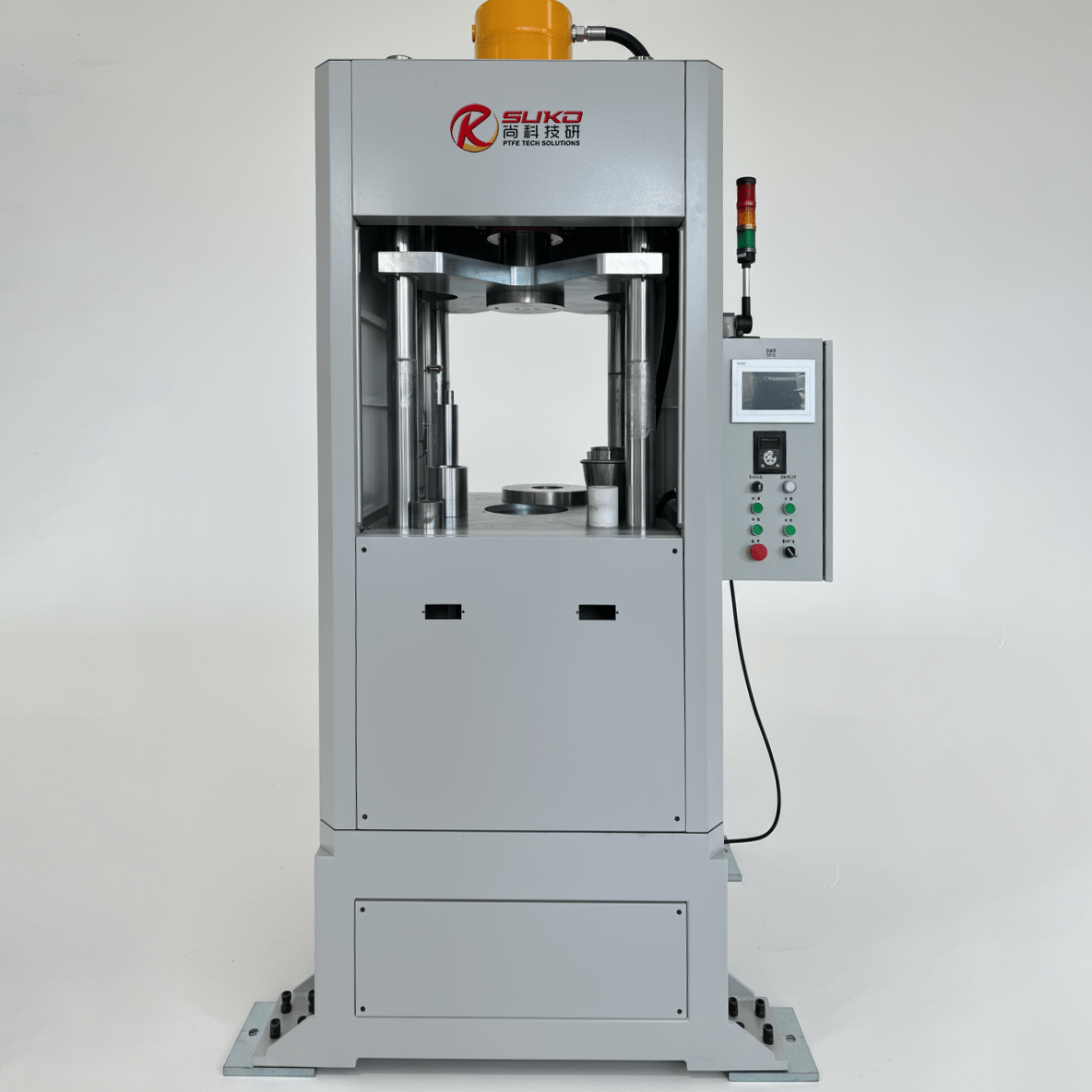
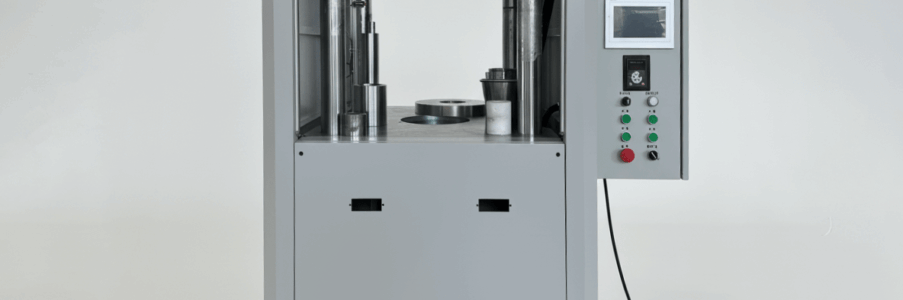
PTFE sleeves, sealing rings and other thick-wall molded parts can develop unevenness during compression molding. The upper, middle and lower sections of the product may not receive exactly the same compacting force. Although the machine reaches the set pressure, differences in pressure transfer can still affect product density, dimensional stability and subsequent sintering.
Why Can One-Way Pressing Create Differences?
After PTFE powder enters the mold, pressure travels gradually from one end to the other. As the product height increases, friction between the powder and the mold wall consumes part of the pressing force. As a result, areas farther away from the pressing head may receive less effective compaction.
Simply increasing the pressure does not always solve the problem. Excessive pressure can increase the load on the mold and may over-compress the area close to the pressing head. Better uniformity also depends on accurate filling, even powder distribution, pressing speed, air release, holding time and controlled pressure release.
How Does Two-Way Pressing Help?
A dual-action PTFE molding machine uses two hydraulic cylinders. The upper cylinder presses downward while the lower cylinder presses upward, allowing the force to travel toward the center of the product from both ends.
This design does not simply double the pressing force. More importantly, it shortens the pressure-transfer distance inside the powder and helps reduce the effects of mold-wall friction and product height. For PTFE sleeves, ring blanks and other molded parts with a certain height or wall thickness, two-way pressing can improve density consistency along the height of the product.
The control program must also match the characteristics of PTFE powder. The machine can run quickly under lower pressure during the initial stage, then reduce speed and increase pressure as the material approaches the forming position. The program can also include air release, pressure holding, pressure compensation and controlled decompression. This helps reduce trapped air and minimizes the effect of sudden pressure release.
The SUKO 63T Dual-Action PTFE Molding Machine
The SUKO 63T dual-action PTFE molding machine uses a vertical structure with upper and lower hydraulic cylinders. Through the touch screen and PLC control system, the operator can complete one-time filling, two-way pressing, pressure holding, air release, decompression, mold opening and ejection according to the preset program.
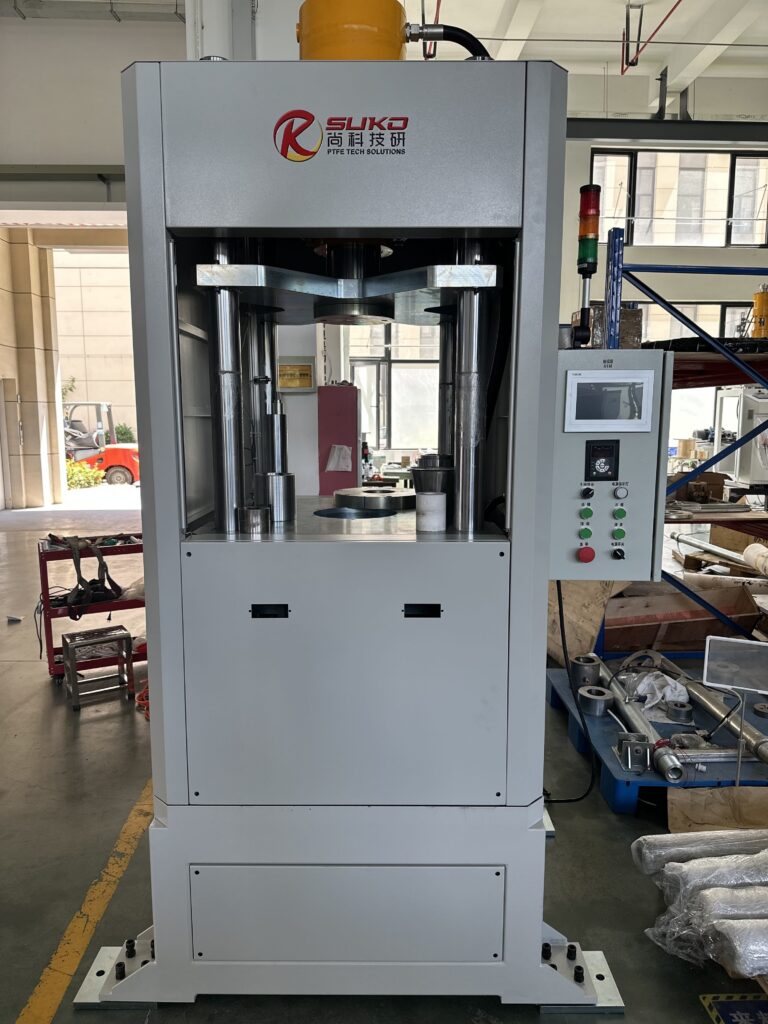
The reference forming outside diameter range is 75-195 mm. The actual available size depends on the product’s inside diameter, wall thickness, height and mold structure. The machine supports automatic high-pressure and low-pressure switching. Pressure sensors monitor the hydraulic pressure so that each stage can run according to the programmed settings.
SUKO has delivered related dual-action PTFE molding equipment to customers in Russia and India. After using the equipment in actual production, both customers gave positive feedback on its performance. These projects also show that two-way pressing is not only a mechanical change. The pressing direction, mold design and control program must work together.
| Параметр | SK-63T Reference Specification |
|---|---|
| Maximum Forming Force | 63 tons |
| Pressing Structure | Vertical, upper and lower hydraulic cylinders |
| Reference Product OD | 75-195 mm |
| Reference Product Height | 0-100 mm |
| Maximum Ejection Height | Up to 150 mm |
| Working Table | 400 × 400 mm |
| Upper and Lower Daylight | 650 mm |
| Effective Stroke | 300 mm |
| Control System | Touch screen and PLC control |
| Pressure Control | Independent dual-pump control with automatic high/low-pressure switching |
| Automatic Process | Pressing, air release, pressure holding, decompression, mold opening and ejection |
| Approximate Machine Size | 2.58 × 0.60 × 0.82 m (H × W × L) |
| Approximate Weight | 1.8 tons |
The specifications above describe one SK-63T project configuration. Product range and machine configuration can be adjusted according to the required dimensions, mold structure and production process.
How Are Product Size and Machine Tonnage Matched?
The rated tonnage of a machine is fixed after the machine is manufactured. Changing the mold does not change the machine tonnage. However, each tonnage has a corresponding product forming range. As long as the product remains within the machine’s specified working range, the available pressing force can meet the PTFE molding requirements.
Within this range, different outside diameters, inside diameters, heights and product structures can be produced by changing the mold and mandrel. If the target product exceeds the available table size, daylight, stroke or forming range, a larger tonnage or a different machine structure may be required.
The 63T model is an actual project example. It does not mean that every PTFE molding project requires a 63T machine. SUKO can evaluate the planned product dimensions and structure, then match the appropriate tonnage, working table, stroke, daylight, mold and control program.
The uniformity of a PTFE molded part depends on the complete process. Two-way pressing can improve pressure transfer, but filling, air release, pressure holding, mold accuracy and subsequent sintering are equally important. Combining the machine structure with the actual product requirements is the key to achieving more stable molding results.

