
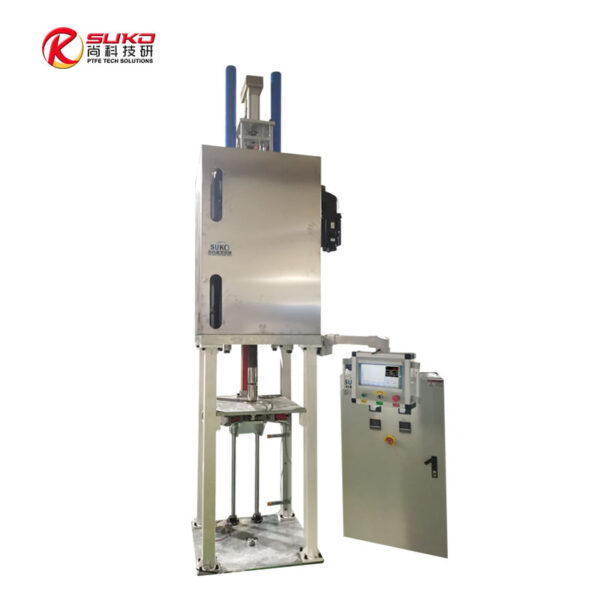
The demand for high-performance PTFE tubing continues to grow rapidly in medical, chemical, aerospace, and industrial fluid transfer applications. As industries require tighter dimensional tolerances and more stable production quality, PTFE hose paste extruder machines have become essential equipment in modern PTFE tube manufacturing.
Based on our experience in PTFE extrusion equipment manufacturing, stable paste extrusion pressure, temperature control, and continuous sintering performance are some of the most important factors affecting PTFE hose quality and long-term production stability.
Modern PTFE paste extrusion technology helps manufacturers improve tubing precision, reduce material waste, and maintain continuous industrial-scale production.
What is a PTFE Hose Paste Extruder Machine?
A PTFE hose paste extruder machine is specialized equipment used for manufacturing PTFE tubing through paste extrusion technology.
Unlike conventional thermoplastic extrusion, PTFE processing requires a unique production method that includes:
- PTFE fine powder preparation
- Lubricant mixing
- Preforming
- Hydraulic ram extrusion
- Continuous sintering and cooling
This process allows manufacturers to produce:
- Smooth bore PTFE hoses
- Convoluted PTFE hoses
- Thin-wall PTFE tubing
- Medical PTFE catheter tubing
- Capillary PTFE tubes
- Multi-lumen PTFE tubing
Because PTFE does not melt-flow like common thermoplastics, stable ram extrusion control is critical for maintaining dimensional consistency and surface quality.
Why Stable Paste Extrusion is Important in PTFE Hose Manufacturing
In PTFE hose production, even small fluctuations in extrusion pressure can affect tube diameter, wall thickness, and concentricity.
During long-term continuous production, manufacturers often focus on:
- Paste pressure stability
- Hydraulic system consistency
- Temperature control accuracy
- Sintering stability
- Tube cooling performance
Based on practical PTFE extrusion production experience, unstable paste pressure is one of the most common causes of dimensional variation in PTFE tubing manufacturing.
For medical and aerospace tubing applications, maintaining stable extrusion conditions is especially important because these industries require extremely tight production tolerances.
Key Advantages of Modern PTFE Hose Paste Extruder Machines
1. High-Precision Tube Extrusion
Modern PTFE hose paste extruder machines use advanced hydraulic ram systems and precision control technology to improve extrusion accuracy.
High-performance extrusion systems help manufacturers achieve:
- Uniform wall thickness
- Stable inner and outer diameter
- Smooth tube surface quality
- Precise concentricity
- Continuous dimensional consistency
For medical PTFE tubing production, precision control directly affects the final performance of catheter and guide wire systems.
Manufacturers producing thin-wall PTFE tubing especially benefit from stable extrusion technology.
2. Automated Production Improves Manufacturing Efficiency
Modern PTFE extrusion production lines typically integrate:
- Automatic feeding systems
- PLC automatic control systems
- Temperature monitoring systems
- Continuous cooling systems
- Automatic cutting systems
Automation reduces manual operation while improving long-term production consistency.
In many PTFE hose manufacturing projects, automated extrusion systems also help reduce material waste and improve operational efficiency.
Compared with conventional manual production methods, automated PTFE extrusion lines provide more stable continuous production performance.
3. Stable PTFE Sintering Performance
After extrusion, PTFE hoses require a stable sintering process to improve mechanical strength and structural stability.
A high-quality PTFE sintering furnace helps maintain:
- Stable heating temperature
- Uniform sintering quality
- Continuous production compatibility
- Energy-efficient operation
In practical PTFE hose production, unstable sintering temperatures may lead to surface defects, dimensional deformation, or inconsistent tube performance.
For manufacturers producing high-performance industrial PTFE tubing, stable sintering control is essential.
PTFE Hose Applications in Different Industries
PTFE hoses produced through paste extrusion technology are widely used across multiple industrial sectors.
Medical Industry
PTFE tubing is commonly used in:
- Interventional catheters
- Guide wire liners
- Heat shrink tubing
- High-purity fluid transfer systems
Medical applications require extremely smooth tube surfaces and high dimensional accuracy.
Chemical Industry
Because PTFE provides excellent chemical resistance, PTFE hoses are widely used in:
- Corrosive fluid transfer systems
- Acid-resistant pipelines
- High-purity chemical processing systems
Aerospace Industry
PTFE hoses are commonly used in aerospace systems because of their:
- High temperature resistance
- Low friction performance
- Long-term reliability
Applications include hydraulic systems, fuel systems, and high-performance fluid transfer systems.
Automotive Industry
Modern automotive systems increasingly use PTFE tubing for:
- Brake hose systems
- Fuel transfer systems
- High-temperature fluid applications
Stable hose quality is critical for maintaining long-term operational safety.
How Reliable PTFE Extrusion Equipment Improves Long-Term Production Stability
When selecting PTFE extrusion equipment, manufacturers usually focus on several important factors:
- Extrusion precision
- Hydraulic stability
- Automation capability
- Sintering performance
- Continuous production reliability
- Technical support capability
Professional PTFE machinery manufacturers can provide customized extrusion solutions for different industrial applications.
Integrated PTFE production lines also help improve production efficiency while reducing long-term operational costs.
Related PTFE Machinery
To improve PTFE hose manufacturing efficiency, many manufacturers combine multiple PTFE processing systems, including:
- PTFE Hose Paste Extruder Machine
- PTFE Tube Ram Extrusion Machine
- PTFE Sintering Furnace
- PTFE Preforming Machine
- PTFE Tube Production Line
You can also learn more about our PTFE machinery manufacturing experience and extrusion technology solutions.
Conclusion
PTFE hose paste extruder machines play a critical role in modern PTFE tubing manufacturing. Advanced hydraulic extrusion systems, stable paste pressure control, automated production technology, and reliable sintering performance help manufacturers achieve higher precision, improved production efficiency, and long-term manufacturing stability.
As demand for high-performance PTFE tubing continues to increase globally, reliable PTFE extrusion equipment will remain essential for medical, chemical, aerospace, and industrial applications.
 English
  Русский