
The Spec Sheet Won’t Tell You How Much Temperature Drift Your Heating Elements Will Show After 18 Months
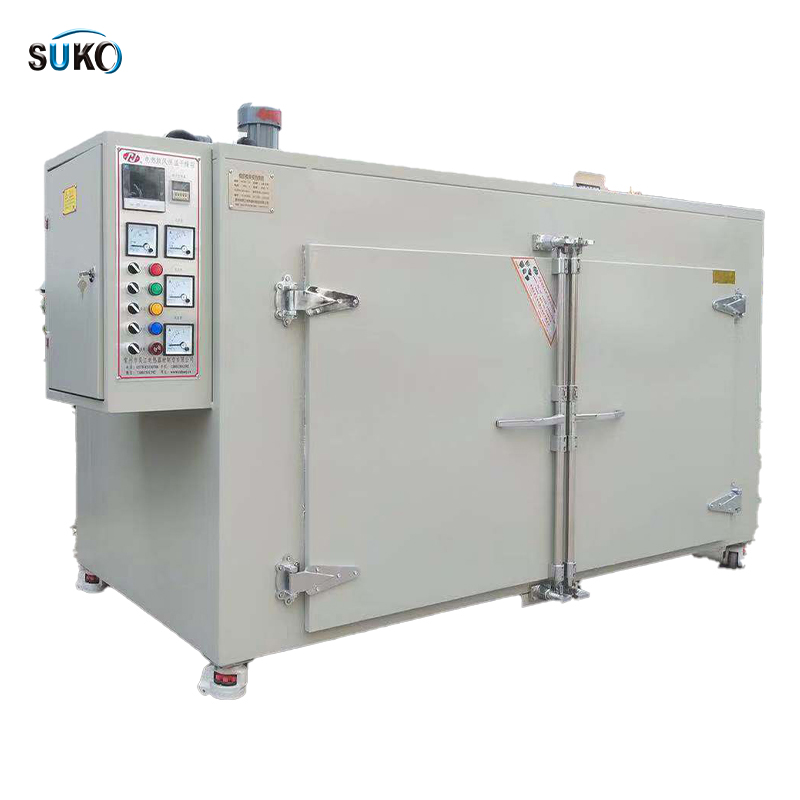
A sintering furnace spec sheet gives you numbers. Maximum temperature. Chamber size. Power rating. What it won’t give you is the number that matters most: how much the temperature control accuracy degrades between now and the day you replace the heating elements.
Most furnaces in this class use nickel-chromium heating wire. When new, they hold their specified accuracy. After 12 to 18 months of continuous operation at 400°C, the wire oxidizes. Resistance changes. Temperature drifts. The furnace that held ±1.5°C on day one is swinging ±4°C or more — and you don’t find out until your scrap rate starts climbing and you can’t trace it to anything obvious.
That’s the difference between a sintering furnace built for PTFE and a general-purpose industrial oven adapted for it. The spec sheet looks the same. What’s inside the walls doesn’t.
This page explains what to look for inside the walls — and why five specific design decisions separate a furnace that holds its accuracy for years from one that doesn’t.
1. Temperature Control Accuracy: Why ±1°C Is the Difference Between a Batch That Passes and a Batch You Scrap
PTFE doesn’t melt like a conventional thermoplastic. It goes through a phase transition where molecular chains reorganize and crystallinity develops. That transition peaks within a narrow band around 328°C. A deviation of 2–3°C changes the crystallization rate enough to alter the part’s mechanical properties — compression set, tensile strength, chemical resistance.
Here’s what that means for the furnace: it needs to hold ±1°C, not ±3°C. A furnace swinging ±3°C across a batch means some parts sinter at 325°C and others at 331°C. Those parts will have measurably different crystallinity. Some will meet spec. Some won’t. The worst case isn’t a batch that fails inspection — it’s a batch where the failing parts aren’t the ones you tested.
European and Japanese furnaces in this class typically specify ±2–3°C. Adequate for general industrial ovens. Inadequate for PTFE. Our specification is ±1°C, achieved through three things that work together:
MoSi2 heating elements with stable resistance over their service life. No drift means no compensation lag.
PID control loops tuned for PTFE thermal profiles, not generic industrial oven profiles.
Chamber insulation designed to eliminate cold spots at door seals and thermocouple ports — the places where most furnaces leak heat and create temperature gradients.
Ask any furnace manufacturer for a temperature uniformity survey at 328°C, under full load, with thermocouple readings from multiple points inside the chamber. If they can’t produce it, their ±2°C claim is a brochure number, not a measured one.
2. Heating Elements: MoSi2 vs. Nickel-Chromium — This Is Where Long-Term Accuracy Is Won or Lost
The heating element is the single biggest variable in how long a furnace holds its accuracy. Most PTFE sintering furnaces use nickel-chromium (NiCr) alloy wire. It’s cheap, it’s widely available, and it works — for a while.
The problem with NiCr is oxidation. At 400°C, NiCr wire develops an oxide layer that changes the wire’s electrical resistance. As resistance changes, power output drifts. The PID controller compensates, but it can only compensate so far. Eventually the drift exceeds the control loop’s range, and temperature swings open up. This doesn’t happen suddenly. It happens over months — which makes it harder to detect until your parts start failing.
We use molybdenum disilicide (MoSi2) heating elements. MoSi2 operates at temperatures up to 1800°C — 500°C is not stressing it. It forms a stable protective silica layer at high temperatures that prevents further oxidation. Its electrical resistance stays consistent over its service life. The temperature coefficient is flat where NiCr’s is drifting.
This is the hardware foundation for ±1°C accuracy. You can’t achieve that precision with elements whose resistance is slowly changing. The PID controller is only as good as the heating elements it’s controlling.
The trade-off is upfront cost. MoSi2 elements are more expensive than NiCr wire. The counterpoint: NiCr elements in a PTFE sintering application will need replacement in 12–24 months of continuous use, and the scrap rate from undetected temperature drift during that period is a cost that doesn’t appear on the furnace invoice. You pay it either way. One shows up as a line item. The other shows up as rejected parts.
3. 30-Segment PID Programming vs. 9–15 Segments: Why It Matters for Thick-Walled Parts
Heating rate isn’t a single number. A 2 mm PTFE gasket can ramp up quickly because heat penetrates a thin cross-section almost instantly. A 50 mm rod cannot. Ramp it too fast and the surface reaches sintering temperature while the core is still 50°C cooler. Thermal expansion differential cracks the part before it ever reaches the crystallization window.
This is where programmable segments become critical. Each segment defines a target temperature, a ramp rate, and a hold time. More segments give you finer control over the shape of the heating curve — particularly through the pre-melt zone where core and surface temperatures need time to equalize.
Most European and Japanese furnaces offer 9–15 programmable segments. That’s enough for simple profiles: ramp to 200°C, hold, ramp to 328°C, hold, cool. But if you’re sintering thick-walled parts, multi-layer laminates, or parts that need staged pre-heating to drive off moisture and low-molecular-weight residues before reaching sintering temperature, 15 segments run out fast. You end up combining phases that should be separate because you don’t have enough segments left.
Our standard is 30-segment PID programming. A typical profile for a thick-walled PTFE part:
Segments 1–5: Room temperature to 200°C at 8°C/min. Moisture removal. Hold.
Segments 6–12: 200°C to 300°C at 3°C/min. Slow ramp through the pre-melt zone to equalize core and surface.
Segments 13–18: 300°C to 328°C at 1.5°C/min. Critical approach to crystallization peak. Slowest, most precisely controlled phase.
Segments 19–24: Hold at 328–330°C. Crystallization window. Duration depends on part thickness.
Segments 25–30: Controlled cooling at 2–5°C/min to below 250°C, then faster cooling to ambient.
With 15 segments, you’re combining some of these phases or skipping the pre-heat altogether. With 30, you have enough resolution to shape each phase precisely. The difference shows up in the parts — especially thick ones.
4. Maximum Temperature: 500°C vs. 400–450°C — Headroom Isn’t a Luxury
A furnace’s maximum temperature rating and its continuous working temperature are not the same thing. A furnace rated for 450°C maximum might only be safe for continuous operation at 380–400°C. Running at the absolute limit stresses heating elements, degrades insulation faster, and pushes control components to their edge.
PTFE sintering typically requires 380–400°C for production runs. If your furnace maxes out at 400°C, you’re running at the redline every day. There’s no headroom for voltage fluctuations, ambient temperature changes, or normal component aging.
Our standard furnace is rated for 500°C maximum, with 400°C specified as continuous working temperature. That 100°C of headroom means the furnace operates well within its design envelope during normal production. Heating elements last longer. Insulation degrades slower. The control system has room to compensate without hitting its ceiling.
It also means process flexibility. PFA, FEP, and some filled PTFE compounds require slightly higher processing temperatures than virgin PTFE. A furnace that tops out at 400°C limits what you can run. A furnace with a 500°C ceiling gives you room to expand your product range without buying another furnace.

5. Customization Capability: 6 Furnaces to Uruguay in One Order
A sintering furnace is a capital purchase with a 10+ year expected service life. The question isn’t just whether the manufacturer can build the standard model. It’s whether they can handle your requirements when they don’t fit the catalog page.
European furnace builders often have high minimum order quantities for custom chamber sizes and extended lead times for non-standard configurations. That works for large multinationals. It doesn’t work for a mid-sized PTFE processor who needs one furnace with a specific chamber dimension and a reasonable delivery timeline.
We delivered six custom sintering furnaces in a single order to Uruguay. Custom chamber dimensions. Custom heating configurations. All six units delivered and operational. This is the scale of customization we handle as standard production — not as an exception with a premium lead time.
India: A client ordering repeatedly for over a decade. When a manufacturer keeps coming back for ten-plus years, the equipment has proven itself across multiple production cycles, operator changes, and maintenance intervals. That’s the long-term stability data point.
Ireland: Export delivery with documented positive client feedback on file.
Taiwan: A complete PTFE production line — our sintering furnace running alongside a PFG150 tube extruder, pre-sintering oven, six-barrel powder mixer, and automatic cutter. All commissioned as an integrated system.
Standard Model Specifications
| Parameter | Specification |
| Chamber Size | 150 × 150 × 150 mm |
| Max Temperature | 500°C |
| Continuous Working Temp | 400°C |
| Control Accuracy | ±1°C |
| Heating Rate | 0–15°C/min (recommended ≤10°C/min) |
| Heating Element | MoSi2 (molybdenum disilicide) |
| Control Method | 30-segment PID programming |
| Power | AC 220V, single-phase, 50/60Hz |
The 220V single-phase power supply matters. Many European furnaces require three-phase 400V. If your facility isn’t wired for three-phase at every workstation, that’s additional electrical work before the furnace can even be plugged in. Our standard model runs on a standard single-phase outlet.
Large Gas-Fired Model for High-Volume Production
For industrial-scale batch production, we build a natural gas-fired sintering furnace:
| Parameter | Specification |
| Chamber Size | 2800 × 3000 × 2000 mm |
| Max Temperature | 420°C |
| Heating Method | Natural gas direct heating |
| Gas Consumption | ≤70 m³/h |
| Power | 3P~480V, 60Hz |
This model is for large PTFE sheets, heavy gaskets, and long-length tubes that won’t fit in a benchtop furnace. Gas heating at this scale keeps operating costs lower than electric — a meaningful factor when the furnace runs every day.
For even larger requirements, we’ve built custom chambers up to 2400 × 8400 × 2000 mm.
Five Questions to Ask Any Sintering Furnace Manufacturer
- Can you show me a temperature uniformity survey at 328°C under full load?
Don’t accept a spec sheet number. Ask for actual thermocouple readings from multiple points inside a loaded chamber at sintering temperature. The acceptable answer is a documented survey showing ±1°C or better. “Our furnaces meet industry standards” with no data behind it is not an answer.
- What heating elements do you use, and what’s the expected service life?
The answer reveals whether the furnace was designed for PTFE or adapted from a general-purpose oven. MoSi2 is the correct answer for precision PTFE work. NiCr wire means you’ll be replacing elements within two years and managing temperature drift until you do.
- How many programmable segments does the controller have?
30 segments is the benchmark for a furnace that can handle complex PTFE profiles with staged pre-heating and precise cooling ramps. 9–15 segments limits what you can do with thick-walled or large-cross-section parts.
- Can you show me a recent multi-unit order?
A manufacturer who has delivered six custom furnaces in a single order has the production capacity for your requirements — whether you’re ordering one unit or ten. Ask for specifics: which country, how many units, what customizations were involved.
- What’s the lead time on spare heating elements?
Every heating element eventually needs replacement. The question is how long you’ll wait. Our MoSi2 elements, control modules, and thermocouples are kept in stock. Response time is measured in days, not weeks.
Factory in Changzhou. Bring Your Parts. Test Your Process.
Our Changzhou facility builds and tests sintering furnaces daily. The factory is open for visits.
If you’re evaluating a PTFE sintering furnace, bring sample parts. We’ll program the temperature curve to your specifications. You watch the controller hold ±1°C through the crystallization window. You measure the results. You decide.
If you need a sintering furnace that holds a number on a spec sheet, there are cheaper options. If you need one that holds temperature when your parts are inside it, come test it.
 English
  Русский