
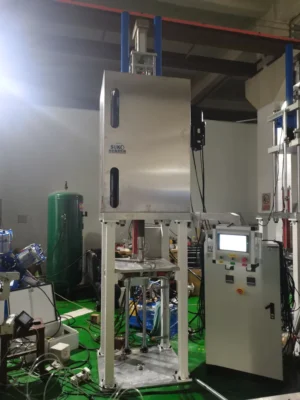
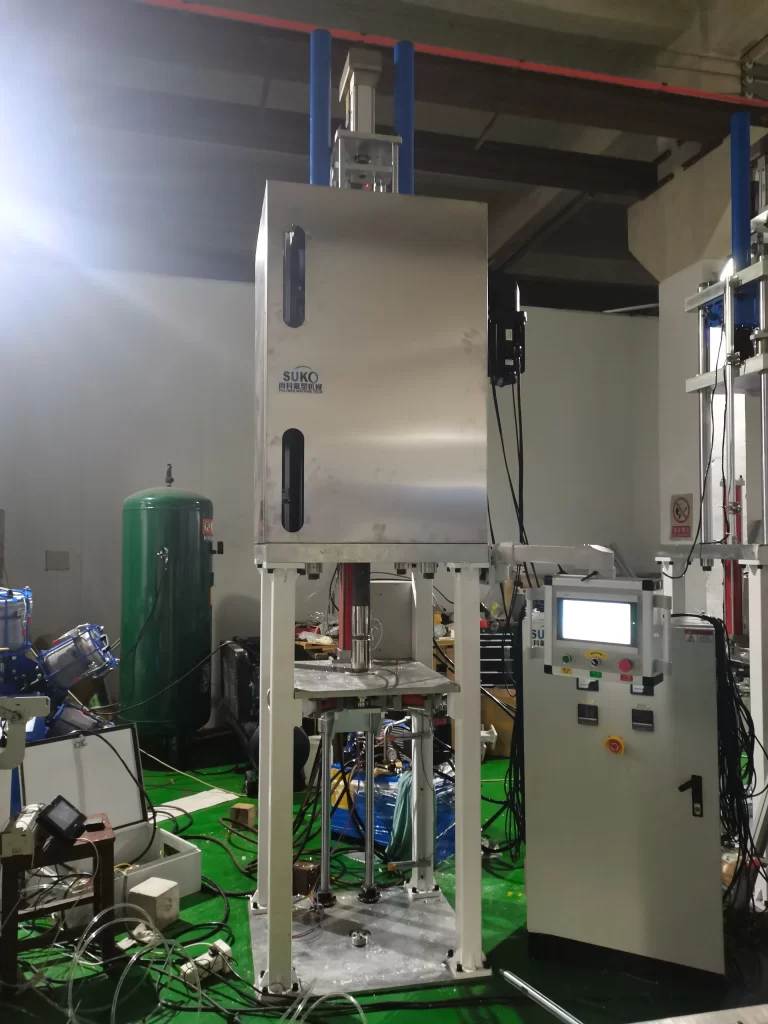
A PTFE paste extruder purchase is a multi-year operational commitment. The difference between a machine that prints money and one that burns it comes down to the questions you ask before the purchase order is signed. This article lists the seven questions experienced buyers always ask—and the answers that separate genuine manufacturers from the rest.
Q1: Is This Supplier Actually a Manufacturer, or Just an Assembler?
The industry’s worst-kept secret: many “manufacturers” buy critical sub-systems from third parties and bolt them together under their own brand. When wall thickness drifts out of tolerance, they cannot trace the root cause because they did not engineer the hydraulic circuit, the die geometry, or the control logic. You inherit a debugging project with no owner.
The Answer: SUKO has manufactured complete PTFE extrusion systems since 2004 in its own Changzhou factory. The hydraulic drive unit, ram, barrel, die heads, and multi-zone sintering furnace are all designed, machined, assembled, and tested under one roof. We do not purchase pre-extruded tube and assemble machines around it. We build the entire system. Buyers are welcome to visit the factory floor and see every production stage.
Q2: Can This Machine Actually Produce the Specs I Need?
A specification sheet is a promise printed on paper. The gap between “rated capacity” and sustained production performance is where money disappears. The only evidence that matters is verified data from operating production lines.
The Answer: The SUKO PTFB80 produces 3-150 mm OD, 0.5-10 mm wall thickness, with sustained tolerance of +/-0.05 mm. These numbers are not theoretical values from CAD software. They are documented from actual production runs at customer facilities in Korea and Vietnam. Serious buyers can schedule a factory visit to witness live measurement data on operating equipment.
Q3: How Long Does Commissioning Really Take?
The industry norm is brutal: 3 to 4 months from machine arrival to first conforming product. Every day of commissioning consumes expensive PTFE fine powder, ties up skilled labor, and delays revenue. The root cause is almost always the same: the machine arrives as blank hardware with no pre-loaded process parameters. Your team becomes an unpaid R&D department.
The Answer: SUKO machines ship with a pre-loaded library of validated process recipes. Ram speed curves, pressure ceilings, and multi-zone sintering temperature profiles are already in the PLC when the machine arrives. Commissioning is not a research project – it is a setup procedure. Our documented average: 6 weeks from arrival to first conforming product shipped to an end customer.
Q4: What Happens to My Line in Year 3 When Parts Wear Out?
Every extruder eventually needs replacement seals, die components, or heater elements. If those parts are proprietary European single-source items with 14-week lead times, a simple seal failure becomes a quarter-long production shutdown. The machine’s purchase price is irrelevant if you cannot keep it running.
The Answer: SUKO uses standard industrial components manufactured in-house. There is no proprietary European seal with a single-source supply chain. We maintain parts inventory for all current models and for machines discontinued more than five years ago. When you need a replacement hydraulic seal or die component, it ships from our warehouse – not from a backlogged third-party supplier in another continent.
Q5: What Can This Machine NOT Do?
Every extruder has physical limits. A supplier who claims their machine “can do everything” is either technically ignorant or commercially dishonest. The honest answer to this question is the strongest signal of engineering competence you can receive.
The Answer: A SUKO paste extruder is not designed for: ultra-micro capillary tubing below 3 mm OD (requires specialized micro-extrusion equipment), melt-processable fluoropolymers like FEP or PFA (requires screw extrusion, not ram extrusion), or continuous screw-based melt processing. If your application falls outside our machine’s genuine capability envelope, our engineers will tell you directly – before you sign anything.
Q6: How Does a Chinese Machine Compare to European or Japanese Brands?
European machines are stable but expensive, with 16-20 week lead times and 14-week parts lead times. Chinese machines are attractively priced but quality varies from excellent to unusable. The real question is whether a specific Chinese manufacturer can deliver European-level precision with Chinese responsiveness.
The Answer: When a Korean PTFE tube factory replaced a European second-tier brand with a SUKO PTFB80, the operational data told a clear story:
| Comparison Dimension | European Brand (Before) | SUKO PTFB80 (After) |
| Commissioning Duration | 4 months | 6 weeks |
| Steady-State Scrap Rate | 12% | 2% |
| Delivery Lead Time | 16-20 weeks | 45-60 days |
| Parts Lead Time (Critical) | 14 weeks (single source) | In stock (standard part) |
| Relative Capital Cost | 40-60% higher | Competitive |
This is not a theoretical comparison. It is a documented before-and-after from a production environment.
Q7: What Do Other Buyers in My Industry Say?
The most valuable due diligence comes from peers who operate the same machine, produce similar specifications, and face similar commercial pressures. They can tell you whether commissioning really took six weeks and whether parts arrive when promised.
The Answer: A Korean PTFE tube manufacturer achieved full return on investment in 18 months after replacing their European machine with a SUKO PTFB80. Scrap rate dropped from 12% to 2%. Production throughput increased by 30%. A Vietnamese factory running the same model logged six consecutive months with zero unplanned downtime. These numbers come from factory acceptance test records and customer production logs – they are verifiable, not anecdotal.
How to Read a PTFE Extruder Spec Sheet — The 6 Criteria That Actually Matter
When you evaluate any Teflon tube extrusion or PTFE hose paste extruder equipment, these six dimensions determine whether you buy a profit center or a problem.
| Evaluation Criterion | What a Good Machine Looks Like | What a Weak Machine Hides |
| Pressure Stability | Closed-loop hydraulic control, fluctuation < +/-0.5 MPa | Simple relief valve, pressure drifts with oil temperature |
| Wall Thickness Uniformity | +/-0.05 mm sustained across full production runs | Initial samples within spec, drifts after 30 minutes |
| Commissioning Time | Pre-loaded process recipes, <= 6 weeks | Blank hardware, 3-4 months of trial-and-error |
| Sintering Temperature Control | Multi-zone PID control, <= +/-2 degC stability | Single-zone heating, wide fluctuations |
| Parts Availability | Domestic standard components, 72-hour response | Proprietary imports, 14-week lead time |
| Supplier Track Record | 19 years, 40+ countries, verifiable cases | New entrant, no documented installation history |
SUKO on Each Criterion — What the Answer Looks Like in Practice
Pressure Stability: Our hydraulic system uses closed-loop proportional valve control with PLC sampling thousands of times per second. This active compensation eliminates the low-frequency pressure oscillations that cause wall thickness drift in simpler systems.
Wall Thickness Uniformity: Documented +/-0.05 mm tolerance end-to-end, verified by laser measurement on every machine before shipment and corroborated by continuous production data from Korean and Vietnamese customer lines.
Commissioning Time: Pre-loaded, validated process recipes mean the machine arrives knowing how to produce common specifications. A new operator can be trained in 30 minutes. First conforming product ships within 6 weeks.
Sintering Temperature Control: 500 degC maximum with multi-zone PID control and hot air circulation. Oven uniformity is verified at +/-5 degC across the full profile during factory acceptance testing.
Parts Availability: All critical components are manufactured in-house to standard industrial specifications. Parts ship within 72 hours for both current models and discontinued legacy systems.
Supplier Track Record: Founded in 2004, Changzhou. Equipment exported to 40+ countries including the United States, Germany, Japan, and South Korea. Used in chemical processing, pharmaceutical, food-grade, and semiconductor applications.
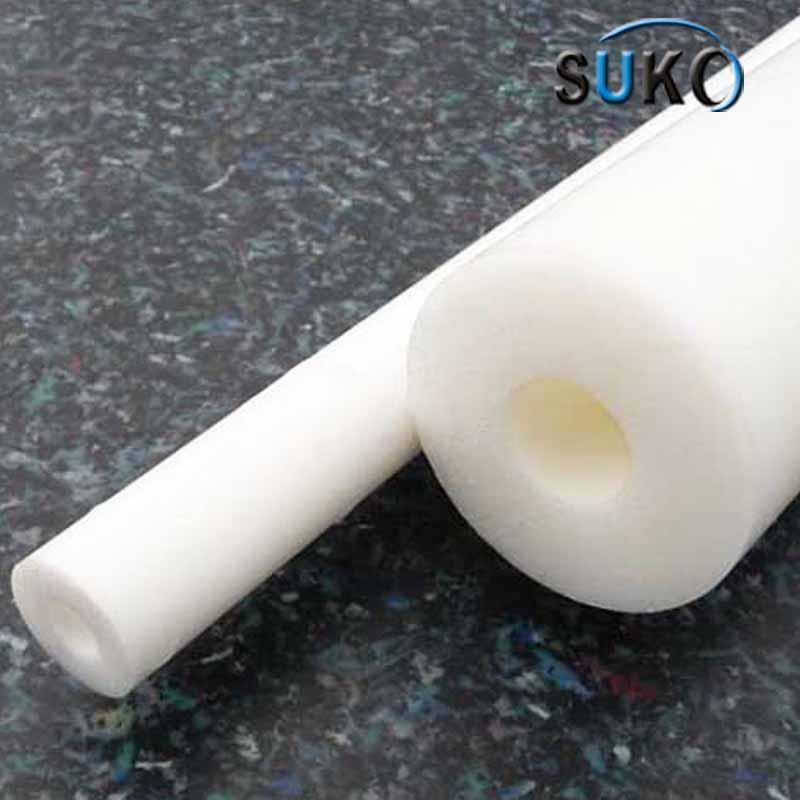
Core Technical Specifications
| Parameter | Specification |
| Maximum Extrusion Pressure | 20 MPa |
| Outer Diameter Range | 3 – 150 mm |
| Wall Thickness Range | 0.5 – 10 mm |
| Tolerance | +/-0.05 mm |
| Maximum Sintering Temperature | 500 degC (multi-zone PID controlled) |
| Control System | PLC + HMI touchscreen |
| Die Changeover Time | <= 2 hours |
| Typical Lead Time | 45-60 days |
From Red Ink to Black — Verified Installation Data
Korean PTFE Tube Factory
Previous equipment: European second-tier brand, 4-month commissioning, 12% scrap rate
After SUKO PTFB80 installation: 6-week commissioning, 2% scrap rate, 30% throughput increase
Full ROI: 18 months
Current status: Stable production on the same machine, three years after installation

Vietnamese Factory
SUKO PTFB80 operating for 6 continuous months
Unplanned downtime events: 0
Replacement parts required: 0
FAQ — The Questions We Hear Before Every Order
- How long is your lead time? 45-60 days from order confirmation, including Factory Acceptance Testing and complete quality documentation.
- Do you provide on-site commissioning and training? Yes. Every machine includes on-site start-up by a SUKO engineer, process recipe handover, and operator training. We remain on-site until the first conforming product ships to your customer.
- What OD and wall thickness range can one machine cover? 3 mm to 150 mm OD, 0.5 mm to 10 mm wall thickness. Achieved through quick-change die tooling on a common machine platform – no separate machine required for different size ranges.
- Can you produce non-standard specifications? Yes. SUKO engineers design custom die configurations for non-standard OD/wall thickness ratios. Custom die lead time: 3-4 weeks.
- What if I need parts for a machine purchased 5 years ago? We maintain parts inventory for all current and discontinued models. All critical components are manufactured in-house – no single-supplier dependency exists.
- Is your machine suitable for medical-grade PTFE tube production? Yes. Our Medical-Grade PTFE Hose Paste Extruder is designed for pharmaceutical and medical device applications. FDA-compliant documentation and full material traceability are available on request.
19 Years, 40+ Countries — The Credentials Behind the Numbers
Founded in 2004, Changzhou, China
Specialized PTFE processing equipment manufacturer – not an assembler
Exported to 40+ countries including the United States, Germany, Japan, South Korea, Vietnam, India, Southeast Asia, and the Middle East
Equipment deployed across chemical processing, pharmaceutical, food-grade, and semiconductor industries
Every machine undergoes laser measurement, sustained hydraulic pressure testing, and sintering oven uniformity verification before shipment
Complete Your Production Line — Related Equipment
PTFE Hose Paste Extruder — for complete hose production lines.
PTFE Corrugated Machine — for chemical and pharmaceutical grade corrugated tubing.
Teflon Tube Extrusion — for high-precision tube manufacturing.
Polymer Molding Machine — for automated PTFE seal and gasket production.
PTFE Sintering Furnace — for controlled high-temperature sintering.
For buyers also sourcing finished PTFE hose and tubing, SUKO supplies certified product to pharmaceutical and chemical buyers globally — explore www.sukoptfe.com.
For medical-grade PTFE tubing production lines, our equipment is documented for GMP compliance — learn more at www.fobospolymer.com.
 English
  Русский